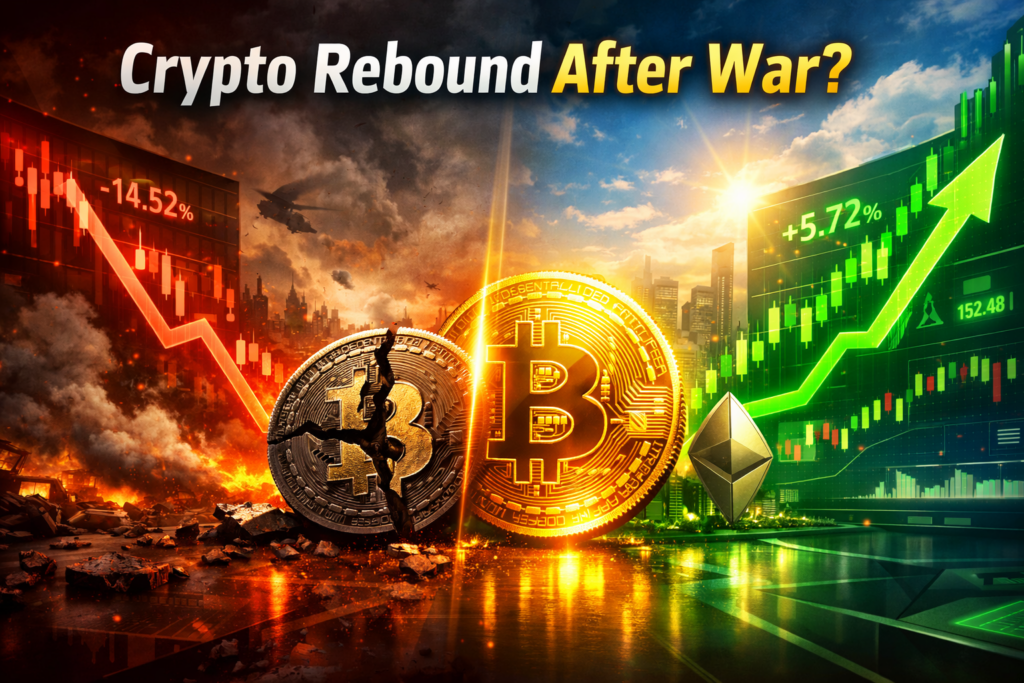

The global financial markets in 2026 have been deeply impacted by the Iran–Israel conflict. Since the war began in late February, both stock and crypto markets have faced strong volatility due to rising oil prices, inflation fears, and geopolitical uncertainty.
However, as discussions around de-escalation emerge, investors are now asking an important question: what could crypto recovery after war look like if tensions ease or the conflict ends?
Bitcoin, which was trading near 73,000 dollars earlier this year, dropped to the 65,000–68,000 range during peak tension. Ethereum also corrected toward 2,000–2,200 dollars. The total crypto market capitalization declined from nearly 2.7 trillion dollars to around 2.4 trillion dollars.
Despite these corrections, markets are showing early signs of stability. This suggests that crypto recovery after war may not only be possible but could happen faster than expected once uncertainty fades.
Impact of Iran–Israel War on Crypto Markets
The war triggered a global shift toward risk-off behavior. Investors moved capital away from volatile assets like cryptocurrencies and into safer options such as bonds and commodities.
One of the biggest impacts was seen in oil prices. Crude surged above 110 dollars per barrel, increasing inflation concerns worldwide. Higher inflation reduces liquidity and limits investment in risk assets, which directly affected crypto markets.
At the same time, stronger dollar conditions and rising interest rates made traditional investments more attractive. Institutional investors reduced exposure to crypto, adding further selling pressure.
This environment created fear and uncertainty, leading many investors to question whether crypto could recover at all. However, history suggests that such phases often precede strong rebounds, reinforcing the idea of crypto recovery after war.
Latest Crypto and Market Stats in 2026
- Global crypto market cap dropped from approximately 2.7 trillion dollars to around 2.4 trillion dollars
- Bitcoin corrected by nearly 8 to 12 percent from recent highs
- Ethereum declined by around 12 to 15 percent during peak volatility
- More than 500 million dollars in liquidations occurred during high volatility sessions
- Oil prices surged above 110 dollars per barrel during the conflict
- Global markets experienced trillions in value erosion during peak panic
- Trading volumes increased significantly during crash phases
- Market sentiment entered extreme fear levels below 30
- Stablecoin dominance increased, indicating defensive positioning
- Markets showed quick recovery signs when de-escalation signals appeared
These numbers indicate that the decline was driven by external factors rather than a collapse of the crypto ecosystem. This strengthens the case for crypto recovery after war.
Early Signs of Crypto Recovery
Recent market behavior suggests that recovery may already be beginning. When early signals of potential de-escalation appeared, both crypto and stock markets reacted positively.
Bitcoin showed upward movement toward 68,000 dollars, while major altcoins also experienced short-term gains. This indicates that investor confidence can return quickly when geopolitical risk decreases.
Such reactions highlight how sensitive markets are to global events. Once uncertainty reduces, capital flows back into growth assets. This is a strong indicator that crypto recovery after war is already taking shape.
Why Crypto Can Recover After War
There are several reasons why crypto markets tend to rebound after geopolitical conflicts. Reduced uncertainty plays a major role in restoring investor confidence.
Lower oil prices ease inflation pressure, allowing central banks to adopt less aggressive policies. This improves liquidity in financial markets.
Institutional investors often return once stability is restored, bringing significant capital into the market. Retail participation also increases during recovery phases.
These combined factors create a favorable environment for growth, making crypto recovery after war a realistic expectation.
Strategy for Investors During Recovery Phase
- Focus on long term investments instead of short term speculation
- Use dollar cost averaging to manage volatility
- Invest in fundamentally strong cryptocurrencies like Bitcoin and Ethereum
- Keep a portion of funds in stable assets for safety
- Avoid leverage and high risk trading strategies
- Diversify across different sectors within crypto
- Stay informed about global economic and geopolitical developments
Following these strategies helps investors benefit from crypto recovery after war while minimizing risks.
Common Mistakes to Avoid
During uncertain market conditions, emotional decisions often lead to losses. Panic selling during market dips is one of the most common mistakes.
Another mistake is waiting too long for confirmation of recovery, which can result in missed opportunities. Markets often move quickly, and delays can reduce potential gains.
Some investors also chase hype-driven assets during recovery phases, increasing risk exposure. Avoiding these mistakes is essential to make the most of crypto recovery after war.
Real Market Behavior During De-escalation
Recent events have shown how quickly markets can react to positive developments. When signs of reduced conflict appeared, global markets responded with strong upward movement.
Oil prices began to stabilize, and investor sentiment improved significantly. This created a chain reaction where capital started flowing back into equities and cryptocurrencies.
Such patterns are common in financial markets. As geopolitical risks decline, investors regain confidence and re-enter the market. This is exactly how crypto recovery after war unfolds in real scenarios.
Opportunities in Post-War Market
A recovery phase creates valuable opportunities for investors. Prices are often lower compared to previous highs, allowing accumulation at better levels.
Projects with strong fundamentals continue to grow even during downturns. Investors who focus on long term value rather than short term price movements are better positioned for success.
Instead of fearing volatility, smart investors use it as an opportunity. This mindset is key to benefiting from crypto recovery after war.
Long Term Outlook for Crypto
The long term outlook for crypto remains positive despite short term challenges. Adoption continues to grow across industries, and blockchain technology is expanding rapidly.
Institutional involvement is expected to increase once global stability improves. Governments and corporations are also exploring digital assets, adding further credibility to the ecosystem.
These factors indicate that crypto is evolving rather than declining. This reinforces the idea that crypto recovery after war is part of a broader growth cycle.
Also Read – When to Sell Crypto for Profit: Smart Exit Strategy 2026
Conclusion
The Iran–Israel conflict has created significant volatility in global markets, including crypto. Rising oil prices, inflation fears, and uncertainty led to a strong correction phase.
However, early signs of recovery are already visible. Markets have responded positively to even minor signs of de-escalation, showing how quickly sentiment can shift.
The concept of crypto recovery after war is not just theoretical. It is already reflected in market behavior. Investors who remain patient, follow disciplined strategies, and focus on long term fundamentals are more likely to succeed.
Rather than reacting to fear, this is the time to prepare for the next growth phase in the crypto market.
FAQs
1. Will crypto recover after the war ends?
Yes, markets typically recover once geopolitical stability returns.
2. Why did crypto fall during the conflict?
Due to uncertainty, rising oil prices, and reduced risk appetite.
3. Is this a good time to invest in crypto?
Yes, but only with proper strategy and risk management.
4. Which crypto benefits most from recovery?
Bitcoin and Ethereum usually lead the recovery phase.
5. How fast can crypto recover?
Recovery can begin quickly once market confidence returns.